OnePlus is asking people to guess the name of its upcoming affordable smartphone and as listed the OnePlus Lite and OnePlus Z as two options on Amazon India ahead of the official launch. The affordable OnePlus phone has been leaked previously as the OnePlus 8 Lite and subsequently as the OnePlus Z but there’s no confirmation yet on the official name of the upcoming phone. In fact, OnePlus accidentally indicated that the phone could be called OnePlus Nord instead as has been spotted in a now-deleted picture on Instagram.
OnePlus is generating a lot of hype in the heads up to the official unveiling of their upcoming smartphone which marks the company’s re-entry into the affordable segment after the OnePlus X that was launched back in 2015. With the new phone, the company could be looking to stay relevant in the affordable price segment of the Indian smartphone market which it once dominated.
OnePlus Nord Leaked Specifications OnePlus Nord is rumoured to feature a 6.55-inch Full HD+ (2400 x 1080 pixels) AMOLED screen with a 90Hz high-refresh-rate. The leaks have indicated that the phone could have a dual punch-hole cutout in the corner for the selfie camera.The phone will reportedly be powered by Qualcomm Snapdragon 765G chipset with an octa-core processor and Adreno 620 GPU. This is paired with 6GB RAM and 128GB storage and there could be more variants as well.
The OnePlus Nord could come with triple camera setup on the back that consists of a primary 64MP camera, a 16MP ultra-wide-camera and a 2MP macro lens. On the front, there is a 32MP primary camera supported by an 8MP ultra-wide-angle camera for selfies.
It is rumoured to be fitted with a 4,300mAh battery with support for 30W fast charging out-of-the-box. Carl Pei even suggested the phone could be priced as much as the original OnePlus One, which launched at around Rs 22,000. We’ll keep an eye out for the official launch that is rumoured to be tentatively scheduled for July 10.
from Latest Technology News https://ift.tt/2ZgjbKJ
OnePlus 8 and OnePlus 8 Pro are going on sale later today on Amazon India. The OnePlus 8 series was previously available in limited quantities earlier due to production issues likely caused by the Coronavirus outbreak. However, this afternoon, both the OnePlus 8 and OnePlus 8 Pro will go on sale on Amazon India and OnePlus India store.
OnePlus 8 series pricing, sale date and launch offersOnePlus 8 is priced starting at Rs 41,999 for the base variant in Glacial Green colour with 6GB RAM and 128GB storage. The 8GB RAM and 128GB storage variant is priced at Rs 44,999 and comes in Onyx Black colour. The maxed-out variant with 12GB RAM and 256GB storage is up for grabs in Interstellar Glow and Glacial Green colours and is priced at Rs 49,999.
OnePlus 8 Pro is priced starting at Rs 54,999 for the base variant with 8GB RAM and 128GB storage while the maxed-out variant with 12GB RAM and 256GB storage is up for grabs at Rs 59,999.
As part of the sale offers, OnePlus is offering a 10 percent discount for CITI Bank cardholders, an instant cashback of Rs 1,000 on Amazon Pay for those who pre-booked the phone, no-cost EMI of up to 12 months with major banks, benefits worth Rs 6,000 with Reliance Jio and six bonus audiobooks by Audible. As part of the OnePlus Red Cable Club, new users will also get six-months extended warranty and 50GB free cloud storage.
OnePlus 8 alternativesOnePlus 8 is perhaps one of the best mid-range flagship phones to consider if looking for a new smartphone that you can depend upon. However, it’s likely that many people don’t want to spend over Rs 40,000 on a smartphone yet so here are the alternatives you can look at instead.
Realme X50 Pro is available starting at Rs 39,999 and comes packed with the latest Snapdragon 865 chipset as the OnePlus 8 along with 64MP quad cameras on the back and support for 65W fast charging out-of-the-box. The maxed-out variant with 12GB RAM and 256GB storage is available at Rs 47,999 on Flipkart.
The iQOO 3 is one of the most affordable Snapdragon 865 powered smartphones in India as it’s available both in 4G and 5G versions. The iQOO 3 also features an AMOLED screen, a 48MP quad-camera setup but supports 55W fast charging out-of-the-box.
The iQOO 3 starts at Rs 34,999 for the 4G variant with 8GB RAM and 128GB storage while the 256GB storage option retails for Rs 37,990. The 5G variant has 12GB RAM and 256GB storage and is priced at Rs 44,990. There are some cashback offers that buyers can avail which provides cashback of Rs 3,000.
OnePlus 8 Pro alternativesWhile the OnePlus 8 Pro features top-of-the-line specifications, there are other flagship smartphones you can consider especially when you’re spending over Rs 50,000 on a mobile phone.
Xiaomi recently launched the Mi 10, it’s flagship phone in India with a versatile 108MP camera array, Snapdragon 865 chipset, high refresh rate display and support for fast wired/wireless charging. It starts at Rs 49,999 for the base variant with 8GB RAM and 128GB storage and goes up to Rs 54,999 for the other variant with 8GB RAM and 256GB storage.
OnePlus 8 and 8 Pro specificationsOnePlus 8 and OnePlus 8 Pro are both powered by the Snapdragon 865 SoC and are 5G-capable. OnePlus 8 rocks a 6.5-inch FHD+ 90Hz AMOLED display while the same on the OnePlus 8 Pro is a 120Hz QHD+ AMOLED display measuring 6.7-inches. Both are HDR10+ certified and rock in-display fingerprint sensors and punch-hole selfie cameras.
There's a triple camera setup at the back of the OnePlus 8 including a 48MP Sony IMX586 sensor, a 16MP ultrawide lens and a 2MP macro. The OnePlus 8 Pro gets a quad-camera setup with a 48MP Sony IMX689 primary sensor, another 48MP Sony IMX586 sensor with an ultrawide lens, an 8MP telephoto lens with 3x hybrid zoom and a colour filter lens.
The OnePlus 8 is powered by a 4,300mAh battery while the OnePlus 8 Pro is powered by a 4510mAh battery. Both smartphones get charged via a 30W Warp Charge 30T charger. Only the OnePlus 8 Pro goes a step further and boasts of 30W wireless charging support as well. The OnePlus 8 Pro is also IP68-rated water and dust resistant.
from Latest Technology News https://ift.tt/3iaY7xQ
E-commerce giant Flipkart is planning to launch a hyperlocal service that would enable customers to buy items from local stores and have those delivered to them in an hour and a half or less. Yatra, an online travel and hotel ticketing service, is exploring a new business line altogether: Supplying office accessories.
Flipkart and Yatra are not the only firms eyeing new business categories. Dozens of firms in the country have branched out by launching new services in recent weeks, in part to offset the disruption the COVID-19 epidemic has caused to their core offerings.
Swiggy and Zomato, the nation’s largest food delivery startups, began delivering alcohol in select parts of the country last month. The move came weeks after the two firms, both of which are seeing fewer orders and had to let go hundreds of employees, started accepting orders for grocery items in a move that challenged existing online market leaders BigBasket and Grofers.
Udaan, a business-to-business marketplace, recently started to accept bulk orders from some housing societies and is exploring more opportunities in the business-to-commerce space, the startup told TechCrunch.
These shifts came shortly after New Delhi announced a nationwide lockdown to contain the spread of the coronavirus. The lockdown meant that all public places including movie theaters, shopping malls, schools, and public transport were suspended.
Instead of temporarily halting their businesses altogether, as many have done in other markets, scores of startups in India have explored ways to make the most out of the current unfortunate spell.
“This pandemic has given an opportunity to the Indian tech startup ecosystem to have a harder look at the unit-economics of their businesses and become more capital efficient in the shorter and longer-term,” Puneet Kumar, a growth investor in Indian startup ecosystem, told TechCrunch in an interview.
Of the few things most Indian state governments have agreed should remain open include grocery shops, and online delivery services for grocery and food.
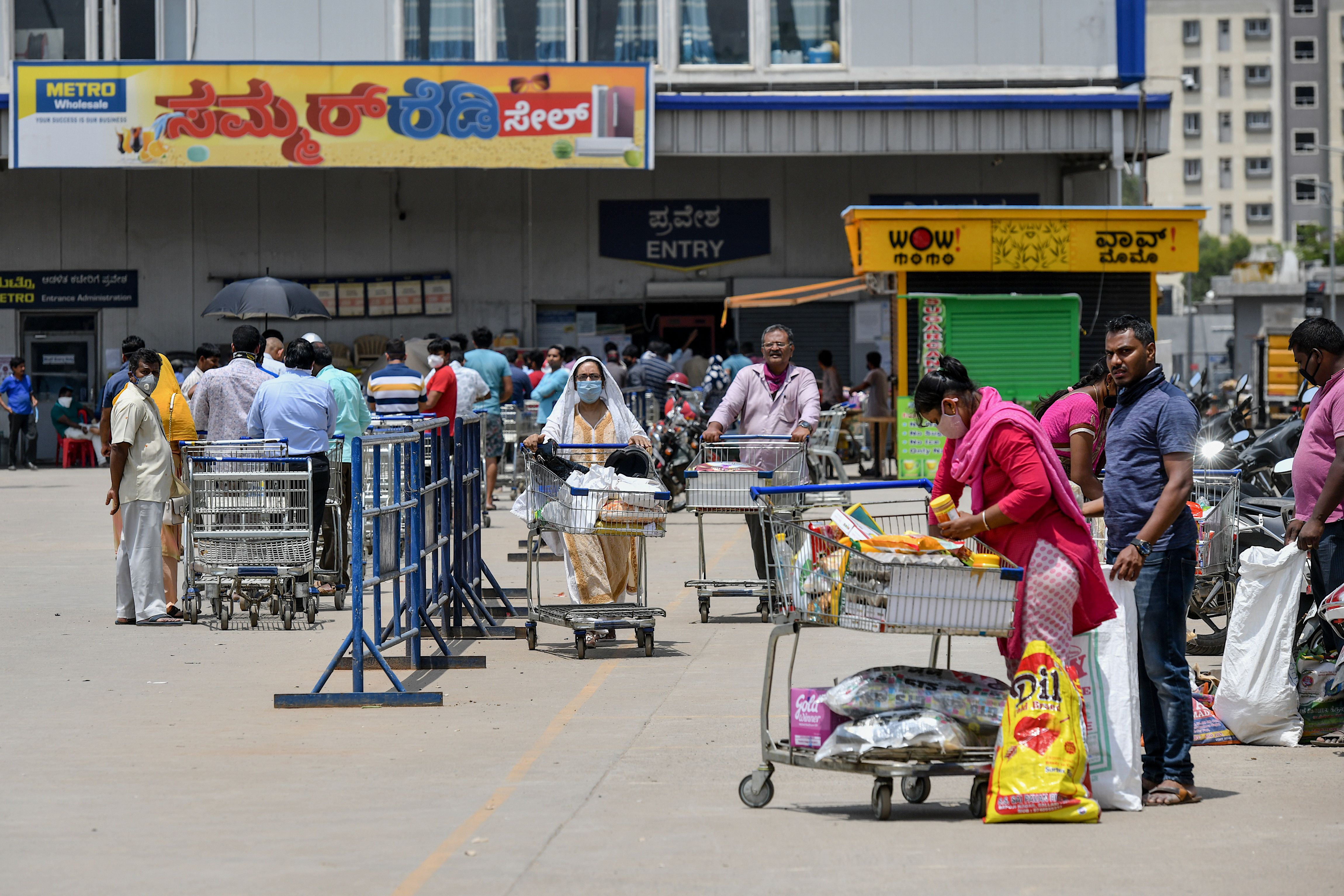
People buy groceries at a supermarket during the first day of the 21-day government-imposed nationwide lockdown as a preventive measure against the spread of the COVID-19 coronavirus, in Bangalore on March 25, 2020. (Photo by MANJUNATH KIRAN/AFP via Getty Images)
E-commerce firms Snapdeal and DealShare began grocery delivery service in late March. The move was soon followed by social-commerce startup Meesho, fitness startup Curefit, and BharatPe, which is best known for facilitating mobile payments between merchants and users.
Meesho’s attempt is still in the pilot stage, said Vidit Aatrey, the Facebook-backed startup’s co-founder and chief executive. “We started grocery during the lockdown to give some income opportunities to our sellers and so far it has shown good response. So we are continuing the pilot even after lockdown has lifted,” he said.
ClubFactory, best known for selling low-cost beauty items, has also started to deliver grocery products, and so has NoBroker, a Bangalore-based startup that connects apartment seekers with property owners. And MakeMyTrip, a giant that provides solutions to book flight and hotel tickets, has entered the food delivery market.
Another such giant, BookMyShow, which sells movie tickets, has in recent weeks rushed to support online events, helping comedians and other artists sell tickets online. The Mumbai-headquartered firm plans to make further inroads around this business idea in the coming days.
For some startups, the pandemic has resulted in accelerating the launch of their product cycles. CRED, a Bangalore-based startup that is attempting to help Indians improve their financial behavior by paying their credit card bill on time, launched an instant credit line and apartment rental services.
Kunal Shah, the founder and chief executive of CRED, said the startup “fast-tracked the launch” of these two products as they could prove immensely useful in the current environment.
For a handful of startups, the pandemic has meant accelerated growth. Unacademy, a Facebook-backed online learning startup, has seen its user base and subscribers count surge in recent months and told TechCrunch that it is in the process of more than doubling the number of exam preparation courses it offers on its platform in the next two months.
Since March, the number of users who access the online learning service each day has surged to 700,000. “We have also seen a 200% increase in viewers per week for the free live classes offered on the platform. Additionally there has been a 50% increase in paid subscribers and over 50% increase in average watchtime per day among our subscribers,” a spokesperson said.
As with online learning firms, firms operating on-demand video streaming services have also seen a significant rise in the number of users they serve. Zee5, which has amassed over 80 million users, told TechCrunch last week that in a month it will introduce a new category in its app that would curate short-form videos produced and submitted by users. The firm said the feature would look very similar to TikTok.
The pandemic “has also accelerated the adoption of online services in India across all demographics. Many who would not have considered buying goods and services online are starting to adopt the online platforms for basic necessities at a faster pace,” said venture capitalist Kumar.
“As far as expansion into adjacent categories is concerned, some of this was a natural progression and startups were slowly moving in that direction anyway. The pandemic has forced people to get there faster.”
Roosh, a Mumbai-based game developing firm founded by several industry veterans, launched a new app ahead of schedule that allows social influencers to promote games on platforms such as Instagram and TikTok, Deepak Ail, co-founder and chief executive of Roosh, told TechCrunch.
ShareChat, a Twitter-backed social network, recently acquired a startup called Elanic to explore opportunities in social-commerce. OkCredit, a bookkeeping service for merchants, has been exploring ways to allow users to purchase items from neighborhood stores.
And NowFloats, a Mumbai-based SaaS startup that helps businesses and individuals build an online presence without any web developing skills, is on-boarding doctors to help people consult with medical professionals.
Startups are not the only businesses that have scrambled to eye new categories. Established firms such as Carnival Group, which is India’s third-largest multiplex theatre chain, said it is foraying into cloud kitchen business.
Amazon, which competes with Walmart’s Flipkart in India, has also secured approval from West Bengal to deliver alcohol in the nation’s fourth most populated state. The e-commerce giant is also exploring ways to work with mom and pop stores that dot tens of thousands of cities and towns of India.
Last week, the American giant launched “Smart Stores” that allows shoppers to walk to a participating physical store, scan a QR code, and pick and purchase items through the Amazon app. The firm, which is supplying these mom and pop stores with software and QR code, said more than 10,000 shops are participating in the Smart Stores program.
from TechCrunch https://ift.tt/3eJjEeK
Astronomers have discovered two super-Earth exoplanets that are orbiting a star 11 light-years away from Earth. The results of the study were published in the journal Science.
According to a report in CNN, the star, Gliese 887 is a small, dim red dwarf star with about half the mass of our sun, But due to its proximity, it is the brightest red dwarf in the sky and is one of the closest stars to our sun.
The report added that a group of astronomers working on the Red Dots project observed the star using the European Southern Observatory in Chile for three months. The High Accuracy Radial velocity Planet Searcher, known as the HARPS spectrograph, detected two planets around Gliese 887.

As per a report in SciTech Daily, researchers made use of the 'Doppler wobble' effect.
The method enabled researchers to measure the tiny back and forth wobbles of the star caused by the gravitational pull of the planets.
Study authors said that the regular signals correspond to orbits of 9.3 and 21.8 days indicating two super-Earths, Gliese 887b and Gliese 887c.
Both planets are larger than Earth and move faster even than Mercury. Scientists estimate the temperature of Gliese 887c to be around 70-degree centigrade, the report said.
According to researchers, since Gliese 887 is not as active as our Sun, the newly discovered planets may retain their atmospheres, or have thicker atmospheres than the Earth, and potentially host life, even though the star receives more light than the Earth.
"The host star Gliese 887 is the best star in close proximity to the sun to understand whether its exoplanets have atmospheres and whether they have life, because it is such a bright and quiet star," lead author Sandra Jeffers, an astrophysicist at the University of Göttingen in Germany, told Space.com.
from Firstpost Tech Latest News https://ift.tt/3dHRHTh
Last week, Facebook announced that it will start labeling newsworthy content that violates the social media company's policies, and label all posts and ads about voting with links to authoritative information, including those from politicians.
A Facebook spokeswoman confirmed Reuters that its new policy would have meant attaching a link on voting information to US President Donald Trump's post last month about mail-in ballots. Rival Twitter had affixed a fact-checking label to that post.

Chief Executive Mark Zuckerberg said in a live-streamed company townhall that Facebook would also ban ads that claim people from groups based on race, religion, sexual orientation or immigration status are a threat to physical safety or health.
The policy changes come during a growing ad boycott campaign, called "Stop Hate for Profit," that was started by several US civil rights groups after the death of George Floyd, to pressure the company to act on hate speech and misinformation.
Zuckerberg's address fell short, said Rashad Robinson, president of civil rights group Color Of Change, which is one of the groups behind the boycott campaign.
"What we've seen in today's address from Mark Zuckerberg is a failure to wrestle with the harms FB has caused on our democracy & civil rights," Robinson tweeted. "If this is the response he's giving to major advertisers withdrawing millions of dollars from the company, we can't trust his leadership."
What we've seen in today's address from Mark Zuckerberg is a failure to wrestle with the harms FB has caused on our democracy & civil rights. If this is the response he's giving to major advertisers withdrawing millions of dollars from the company, we can't trust his leadership.
— Rashad Robinson (@rashadrobinson) June 26, 2020
If Mark Zuckerberg truly "stands against hate," then why is Tr*mp's post saying that "if they start looting, they start shooting" still up?
— Rashad Robinson (@rashadrobinson) June 26, 2020
Zuckerberg's new changes don't go nearly far enough. Labeling "newsworthy" content so the public can judge for themselves is not a new policy. It's more of the same, and it won't cut it.
— Rashad Robinson (@rashadrobinson) June 26, 2020
Zuckerberg's address was 11 minutes of wasted opportunity to commit to change. I hope companies advertising on Facebook were watching - if they want to put their money where their mouth is on racial justice, then it's time to #StopHateForProfit. pic.twitter.com/oz2rLvHBxF
— Rashad Robinson (@rashadrobinson) June 26, 2020
Today's address made it clearer than ever that Mark Zuckerberg's leadership has failed. We need a complete audit of his operations, stat. https://t.co/YrGgUb7ZB3
— Rashad Robinson (@rashadrobinson) June 26, 2020
Meanwhile, Facebook CEO "became $7.2 billion poorer" after the companies pulled advertising from the network, according to a report by Bloomberg.
Shares of Facebook closed 8.3 percent lower, and Twitter's fell 7.3 percent after Unilever PLC said it would stop its US ads on Facebook, Instagram, and Twitter for the rest of the year, citing "divisiveness and hate speech during this polarized election period in the US."
More than 90 advertisers including Japanese carmaker Honda Motor Co Ltd's US subsidiary, Unilever's Ben & Jerry's, Verizon Communications Inc, and The North Face, a unit of VF Corp, have joined the campaign, according to a list by ad activism group Sleeping Giants.
CONFIRMED: @Starbucks will pause all advertising on Facebook and all other social media platforms.#StopHateForProfit https://t.co/boQFSZeMrP
— Sleeping Giants (@slpng_giants) June 28, 2020
The campaign specifically asks businesses not to advertise on Facebook's platforms in July, though Twitter has also long been urged to clean up alleged abuses and misinformation on its platform.
And another one - @Hersheys is joining the push to #StopHateForProfit. @Facebook can either implement a civil rights infrastructure or sacrifice their bottom line. https://t.co/KmUAKstnSl
— Rashad Robinson (@rashadrobinson) June 26, 2020
On 26 June, Coca Cola also told CNBC that it will pause advertising on all social media platforms globally.
"We have developed policies and platform capabilities designed to protect and serve the public conversation, and as always, are committed to amplifying voices from under-represented communities and marginalized groups," said Sarah Personette, vice president for Twitter's Global Client Solutions.
"We are respectful of our partners' decisions and will continue to work and communicate closely with them during this time."
In a statement, a Facebook spokeswoman pointed to its civil rights audit and investments in Artificial Intelligence that allow it to find and take action on hate speech.
"We know we have more work to do, and we'll continue to work with civil rights groups, GARM, and other experts to develop even more tools, technology and policies to continue this fight," she said, referring to the Global Alliance for Responsible Media.
With inputs from Reuters.
from Firstpost Tech Latest News https://ift.tt/3id8yRm
The collision between two black holes is known to send ripples in space and time but is not known to emit light – till now. Astronomers have now revealed that they saw a flare of light coming out when two black holes rapidly spun around each other before making a violent union.
The astronomers claim that this is the first time they have seen a merger of black holes giving off light.
A new study published in the journal Physical Review Letters says that the black holes may have just been in the right place at the right time because of which the researchers observed a flare of light.

This illustration shows a stage in the merger of two galaxies that forms a single galaxy with two centrally located supermassive black holes surrounded by disks of hot gas. The black holes orbit each other for hundreds of millions of years before they merge to form a single supermassive black hole that sends out intense gravitational waves. Image credit: NASA/CXC/A.Hobart
The research has been conducted by a team of scientists from Graduate Center, CUNY, Caltech’s Zwicky Transient Facility (ZTF), Borough of Manhattan Community College (BMCC) and the American Museum of Natural History (AMNH), reported SciTech Daily.
When the celestial dance took place, the black holes were located inside a giant disc of gas and dust. What happened was that their merger created something like a shock wave that crashed into the surrounding dirt and gas. As a result of this, the nearby material got heated, causing the light to emerge.
The collision took place 7.5 billion light-years from Earth and the black holes were about the size of Long Island.
“If it’s two black holes merging, you don’t expect to see anything. But because the black holes are surrounded by this stuff, by this accretion disc, that’s different," reported The Verge quoting Matt Graham, a research professor of astronomy at Caltech and lead author of the study.
The light was observed using the LIGO-Virgo collaboration, an international scientific partnership that’s become increasingly skilled at detecting cataclysmic events like black holes merging.
from Firstpost Tech Latest News https://ift.tt/3eIc2ZT